For years, CBD has existed in an uncomfortable contradiction.
Legal, but constrained.
Commercially visible, but institutionally avoided.
Widely used, but rarely taken seriously at a federal or regulatory level.
The biggest limitation on CBD wasn’t consumer demand.
It was uncertainty—uncertainty around enforcement, regulatory ambiguity, and how cannabinoids would ultimately be governed at the federal level.
That is now changing.
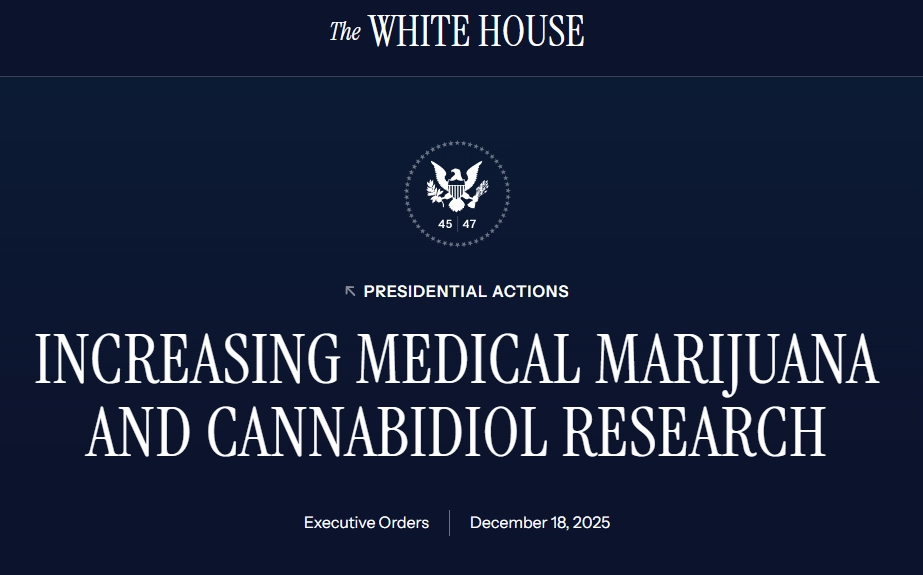
The recent federal executive order directing the rescheduling of cannabis from Schedule I to Schedule III is not a wellness moment. It is not a branding moment. And it is not a shortcut to mass commercialization.
It is a regulatory signal.
And for companies that have built CBD programs around science, safety, and regulatory rigor, it marks a meaningful inflection point.
What the executive order actually changes for CBD
While CBD has been federally legal under the Farm Bill, it has lived in regulatory limbo because federal agencies largely avoided engaging with cannabinoids altogether.
Schedule III rescheduling changes the posture.
It signals federal acknowledgment of cannabinoids as a category that must be actively governed and directs agencies to engage rather than ignore. That shift matters because it removes the largest structural barrier to CBD’s evolution: the absence of a clear, coordinated federal regulatory framework.
This does not mean CBD is suddenly FDA-approved.
It does mean CBD is now being discussed and evaluated within the same institutional and regulatory context as other controlled, high-scrutiny ingredients.
That distinction is everything.
From wellness narratives to regulated industry maturity
The next phase of CBD will not be driven by lifestyle positioning or influencer marketing.
It will be driven by:
- toxicology data
- safety margins
- impurity controls
- dose consistency
- stability and degradation behavior
- defensible specifications
- regulatory documentation that can withstand scrutiny
This executive order accelerates a transition that has been quietly underway for years: CBD moving out of the wellness aisle and into regulated, high-scrutiny product conversations.
That transition favors companies who invested early in infrastructure rather than shortcuts.
Why early regulatory investment now matters
At Mile High Labs, we did not build our CBD platform around market trends. We built it around inevitability.
Long before federal posture shifted, we invested in:
- comprehensive toxicology studies
- GMP manufacturing controls designed for regulated markets
- THC risk management systems
- data-driven specifications designed for regulated end uses
- stability and formulation work suitable for beverages and other regulated product formats
- novel foods dossiers for both the UK and EU
Those investments were not fast.
They were not inexpensive.
And they were not made for short-term wins.
They were made because we believed CBD’s future would ultimately be decided by regulators, institutions, and governed markets—not marketing teams.
The executive order reinforces that thesis.
What this means for brands, formulators, and product teams
As federal agencies re-engage with cannabinoids, the CBD market will narrow before it grows.
Not every product will survive increased scrutiny.
Not every supplier will be defensible.
And not every formulation will meet the standards required for regulated markets.
The questions being asked are already changing:
Can this ingredient withstand regulatory review?
Can I defend it to legal and quality teams?
Can it be exported into regulated international markets?
Can it be supported by safety and research data?
CBD is no longer about access.
It’s about assurance.
Where Mile High Labs fits in the next phase
We work with companies who already understand where this is heading.
Regulated and science-led brands.
Beverage innovators operating under global regulatory constraints.
Product teams building for the UK, EU, Japan, and other high-barrier markets.
Organizations that understand “good enough” is no longer good enough.
The executive order does not create these opportunities—but it validates them.
It signals that CBD’s future will be shaped by evidence, systems, and regulatory credibility.
That is the work we’ve been doing all along.
What’s next
If you are building CBD products intended for:
- regulated food and beverage markets
- high-scrutiny product categories
- international expansion
- long-term institutional adoption
Now is the time to reassess whether your ingredient strategy is built for where the category is going—not where it has been.
We’re happy to have that conversation.
Contact Mile High Labs to discuss compliant CBD ingredient solutions built for regulated markets and the next phase of cannabinoid commercialization.
Sources and References
For readers who want to review the underlying federal actions referenced in this article:
- Executive Order: Increasing Medical Marijuana and Cannabidiol Research Source: WhiteHouse.gov https://www.whitehouse.gov/presidential-actions/2025/12/increasing-medical-marijuana-and-cannabidiol-research/
- White House Fact Sheet: President Donald J. Trump Is Increasing Medical Marijuana and Cannabidiol Research Source: WhiteHouse.gov
https://www.whitehouse.gov/fact-sheets/2025/12/fact-sheet-president-donald-j-trump-is-increasing-medical-marijuana-and-cannabidiol-research/