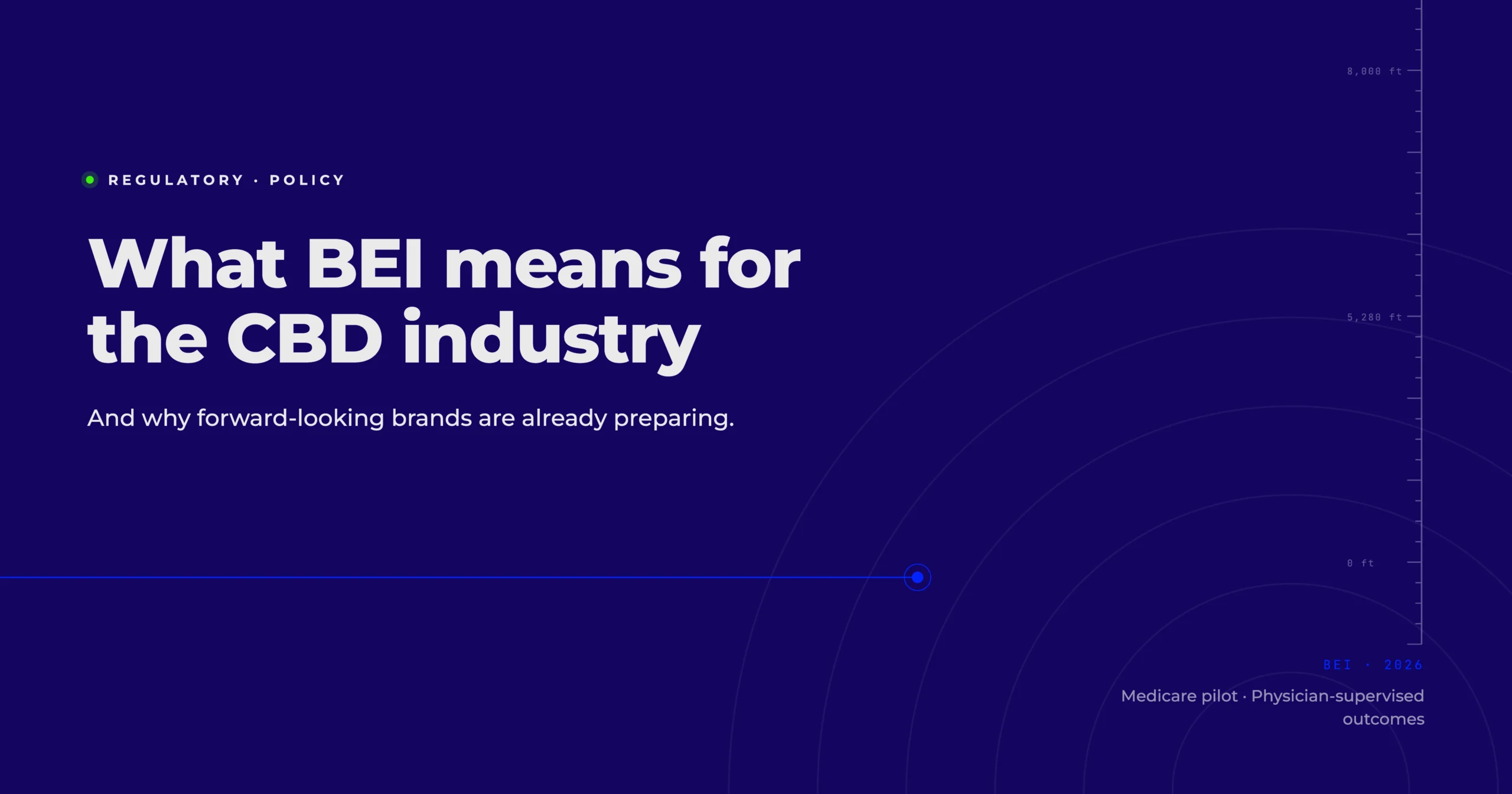
A pilot is underway that could mark the most significant shift in U.S. CBD policy in years. The Substance Access Beneficiary Engagement Incentive —BEI — is testing whether hemp-derived CBD products can be incorporated into patient care plans under clinical guidance.
It is not full Medicare coverage. It is not a federal endorsement. There is no standardized national CBD framework yet, and participation is limited and data driven. But for brands paying attention, BEI matters for one reason: pilot programs like this one are typically the first step toward broader healthcare adoption and policy change.
If your brand has any ambition to operate in healthcare-aligned cannabinoid markets, the time to start preparing is well before the rules are finalized.
What BEI is — and what it isn’t
BEI is a pilot framework, not a finalized program. It is structured to evaluate outcome-based data within defined patient support areas, with eligible products incorporated into clinician-guided care plans under physician supervision.
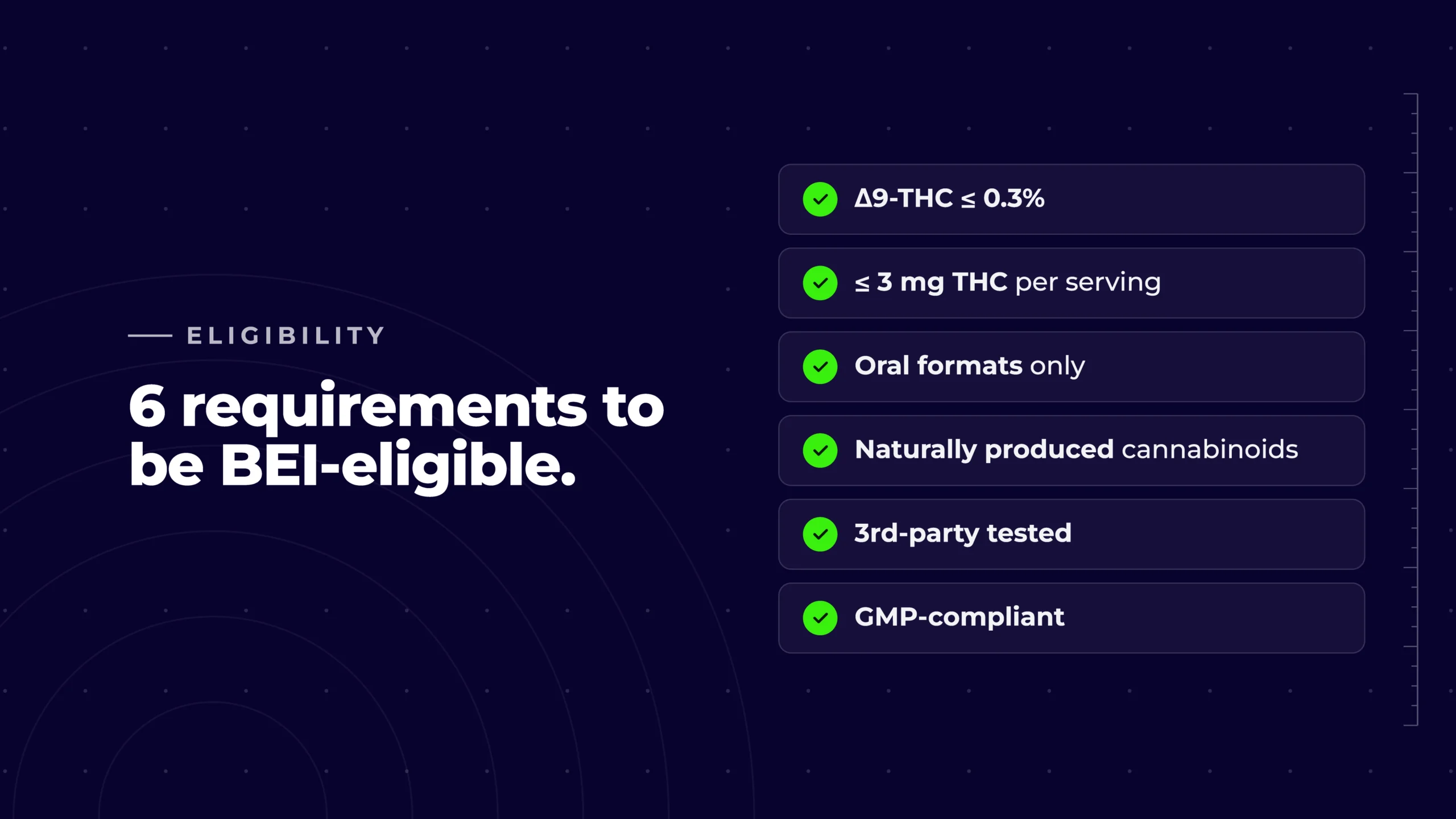
To participate, products must meet six baseline requirements:
- ∆9-THC ≤ 0.3% dry weight
- ≤ 3mg THC per serving (oral)
- Oral formats only — inhalables excluded
- Naturally produced cannabinoids — no synthetics
- Independent third-party testing for potency, contaminants, and microbials
- GMP-compliant manufacturing with a supplement facts panel
These thresholds are not arbitrary. They reflect what physician-supervised programs and Accountable Care Organizations (ACOs) need from a cannabinoid product to track outcomes credibly: consistency, controlled dosing, verified safety, and clean documentation.
The current pilot allocates up to $500 per patient annually. More significant than the dollar amount is what participation signals: that hemp-derived CBD ingredients meeting clinical standards are being evaluated within a formal healthcare framework. Brands with compliant, well-documented ingredient supply chains are positioned to support what evaluation credibly.
The market is shifting — and current approaches won’t fully carry over
Most CBD supply chains were built for less regulated channels. That market rewarded low prices, flexibility, fast iteration, and commodity sourcing. The emerging healthcare-aligned market rewards something different.
| Current Market | Emerging Market |
|---|---|
| Wellness-first | Healthcare-aligned |
| Retail-driven | Data-driven |
| Flexible standards | Defined expectations |
| Commodity sourcing | Trusted supply chains |
Brands moving into healthcare-aligned cannabinoid programs are finding that retail-built supply chains struggle with the new requirements. Repeatable dosing demands tighter manufacturing tolerances. Physician oversight demands toxicology data and safety validation that most ingredient suppliers don’t prioritize. Outcome tracking demands lot-level traceability, consideration of delivery mechanisms, bioavailability, and efficacy.
This is not a small adjustment. It is a structural change in what an ingredient partner needs to provide.
What healthcare-aligned cannabinoids actually require
Five capabilities consistently separate ingredient suppliers built for the next phase of the industry from those built for the last one:
- Consistency — repeatable cannabinoid profiles, batch over batch
- Compliance — meeting evolving regulatory and program-specific requirements
- Traceability — clean chain-of-custody from biomass to finished ingredient
- Repeatable dosing — controlled-dose applications a physician can rely on
- Clinically aligned manufacturing standards — GMP-compliant infrastructure built for controlled applications
These are the requirements healthcare-integrated cannabinoid programs are converging on, regardless of which specific pilot or framework a brand pursues.
Mile High Labs was built around precisely these requirements. The section below details how MHL’s manufacturing infrastructure, safety validation, and regulatory track record map directly to each.
Where MHL fits in the supply chain
Mile High Labs operates upstream — supplying the ingredients and formulation design that finished-goods manufacturers, healthcare-aligned brands, and formulation partners need to participate in programs like BEI.
That positioning is intentional. Several capabilities directly support healthcare-aligned cannabinoid pathways:
- Completed toxicology studies — Genotoxicity and Subchronic Toxicity completed (EU/US-compliant)
- NSF GMP-compliant manufacturing infrastructure
- Third-party tested ingredients across every production lot
- MHL Lowest Limit of Detection Water-Soluble CBD Isolate 2.0 (≤ 0.1 ppm) THC
- Global regulatory experience, with shipments into 30+ regulated markets in 2025
- Pharma-grade ingredient standards designed for consistency in controlled applications
- 2-year stability studies completed across ingredients and formulations, including isolates, emulsions, tinctures, tablets, softgels, and gummies
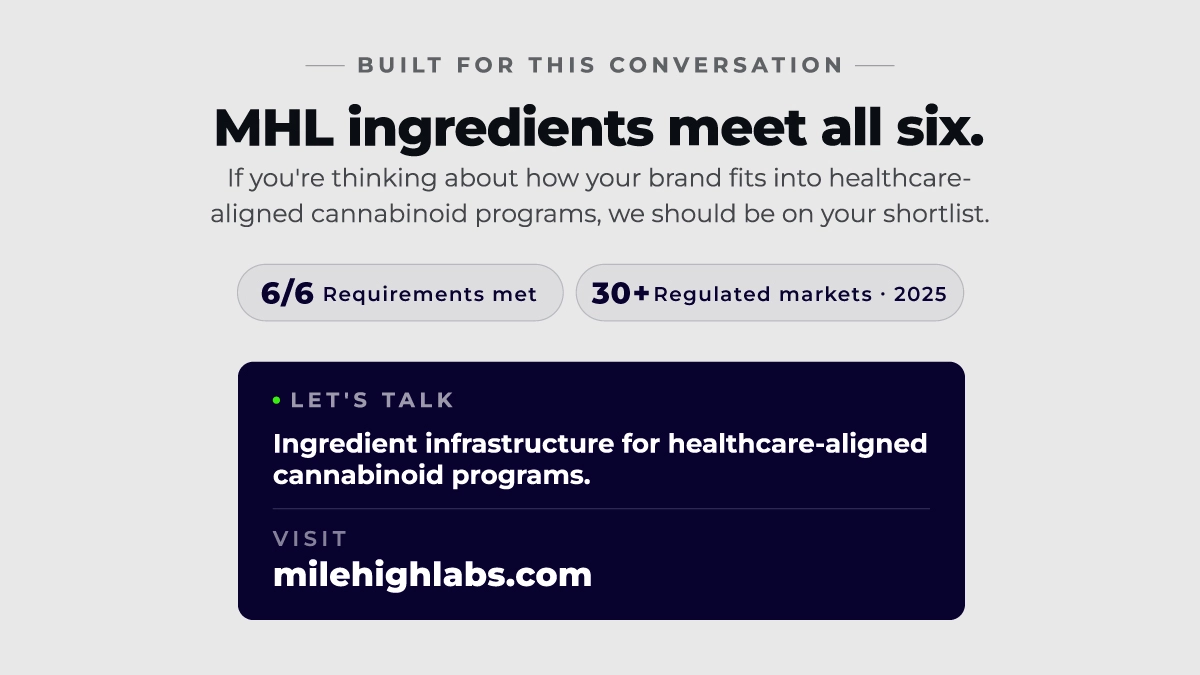
MHL ingredients meet all six BEI eligibility requirements today, supporting formulation, finished-goods, and physician-supervised ACO presentations now. Beyond eligibility, water-soluble formulations using advanced microemulsion technology — with concentrations up to 20% loading (200,000 mg/L) — give formulators flexibility for the controlled-dose product formats healthcare-aligned programs increasingly favor.
Who is preparing now
Several types of operators are already aligning their roadmaps to this opportunity:
- Finished-goods manufacturers who need compliant cannabinoid ingredients for physician-supervised product pathways
- Healthcare-oriented CBD brands preparing for healthcare-integrated positioning
- Formulation partners seeking scalable, controlled-dose ingredient systems
- Regulatory-forward operators preparing for stricter cannabinoid compliance standards
What these operators have in common is a recognition that the businesses positioned to participate in healthcare-aligned cannabinoid programs will be the ones who prepared before the framework was finalized.
Questions worth asking
If your brand is evaluating where it sits relative to BEI and the broader shift, a few questions are worth working through internally:
- How does healthcare-oriented cannabinoid positioning git into our diversification strategy?
- Does our current supply chain support repeatable dosing and third-party validation?
- Are our ingredients backed by toxicology and safety data?
- Would our current formulations withstand tighter compliance expectations?
- Are we positioned to evaluate physician-supervised or healthcare-integrated channels when they expand?
The answers usually surface the gap between where a brand is and where the market is heading.
In Summary
BEI is a pilot. It is limited in scope, data-driven, and not federally approved as a coverage pathway. None of that should be oversold.
What should not be understated is what BEI may represent: the early infrastructure of healthcare-aligned cannabinoid markets in the U.S. Brands that wait for complete regulatory clarity risk competing against operators that have already established the infrastructure, credibility, and positioning years in advance.
If you’re evaluation how your supply chain aligns with healthcare-integrated cannabinoid requirements, Mile High Labs is ready to support that process.
Disclaimer: This article describes a federal pilot program and the technical and regulatory considerations relevant to ingredient suppliers operating in the hemp-derived CBD category. Nothing herein constitutes a claim regarding the therapeutic value of any product. For official program details, consult the CMS Substance Access Beneficiary Engagement Incentive page.
Sources & Additional Reading
Centers for Medicare & Medicaid Services (CMS)
Substance Access Beneficiary Engagement Incentive (BEI)
CMS Innovation Center
BEI Program Overview & Pilot Structure
Foley & Lardner LLP
Legal Analysis of Hemp Product Participation in the BEI Framework