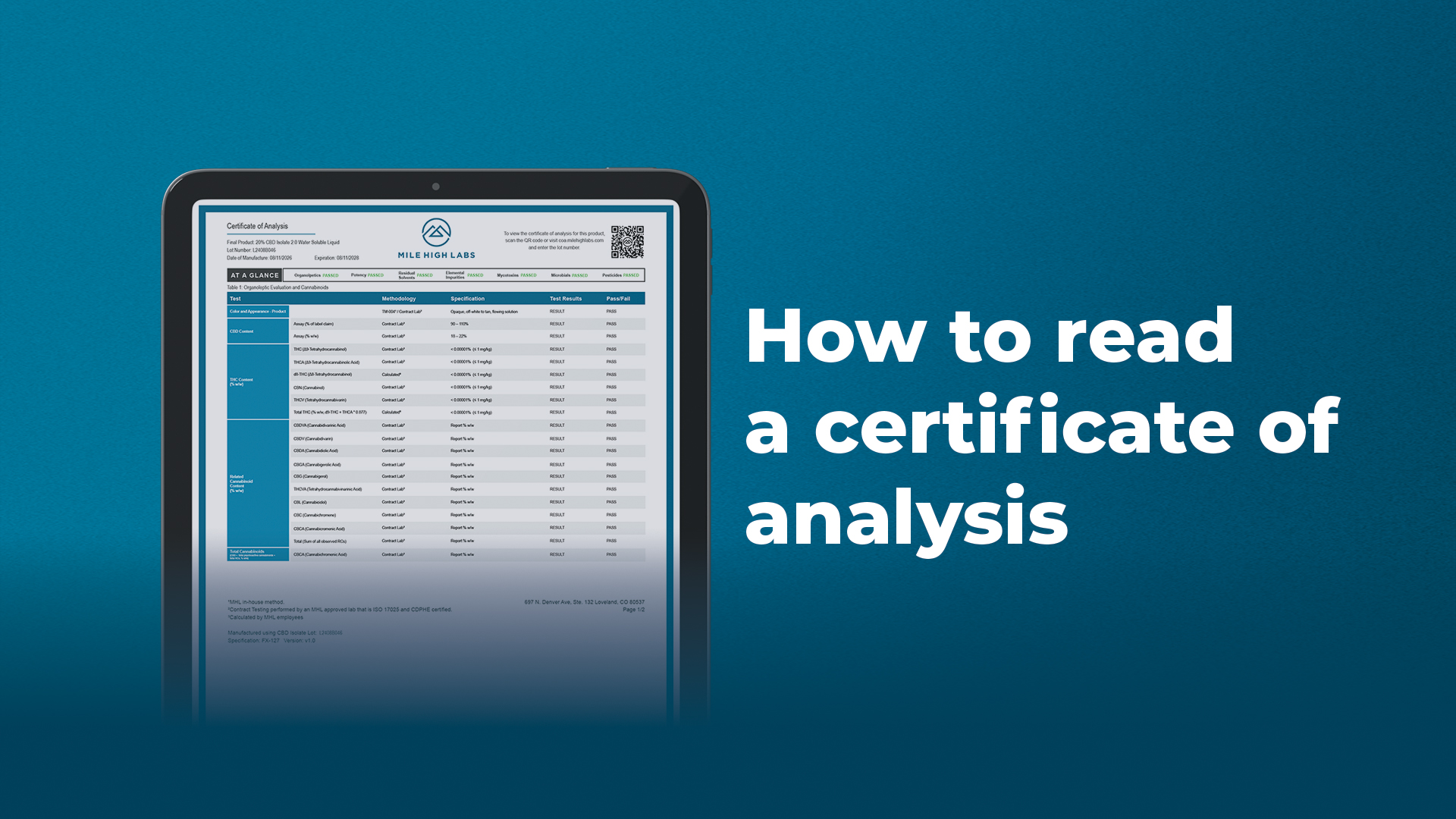
In this post we’ll talk about some things to watch out for when reading your Certificate of Analysis (CoA). As regulation evolves and scrutiny increases on testing limits for controlled cannabinoids, it’s now crucial to build from a foundation of high‑quality ingredients that are tested accurately. Getting the basics right at the certificate stage is what protects everything that comes after.
Why “Non‑Detect” Doesn’t Mean Zero
Open almost any cannabinoid CoA and you’ll find “ND” — non‑detect — in the THC row. It looks definitive: no THC detected, end of conversation. It isn’t.
ND does not mean the compound is absent. It means the compound was not detected by the method used — that the result fell below that method’s limit of detection (LOD).
A non‑detect result is only as meaningful as the detection limit behind it. Set that limit high enough and a material with a significant amount present will still return ND. The certificate is accurate — but it is also telling you very little.
As thresholds tighten across the US, UK, EU and Japan, a certificate that satisfied a buyer three years ago no longer answers the question a regulator is asking now.
The cost of not asking
The consequences show up late:
- A finished product fails specification on receipt.
- A formulation locked to one batch cannot be reproduced from the next.
- Retesting and requalification eat weeks.
- Supply pauses while you resource.
- In the worst case, a compliance failure in‑market traces back to an ingredient certificate nobody interrogated.
None of that is visible at the point of purchase. All of it is decided there.
The Two Numbers That Matter Most: LOD and LOQ
Every validated method carries two critical figures:
- LOD — Limit of Detection: The lowest concentration the method can reliably distinguish from noise.
- LOQ — Limit of Quantitation: The lowest concentration the method can reliably measure.
As a general rule, LOD sits at roughly one third of LOQ.
On low‑threshold certificates, these should be printed. Everywhere else, they should be available on request. If nobody can produce them — or the relationship between them looks wrong — that is worth a question before anything else on the certificate.
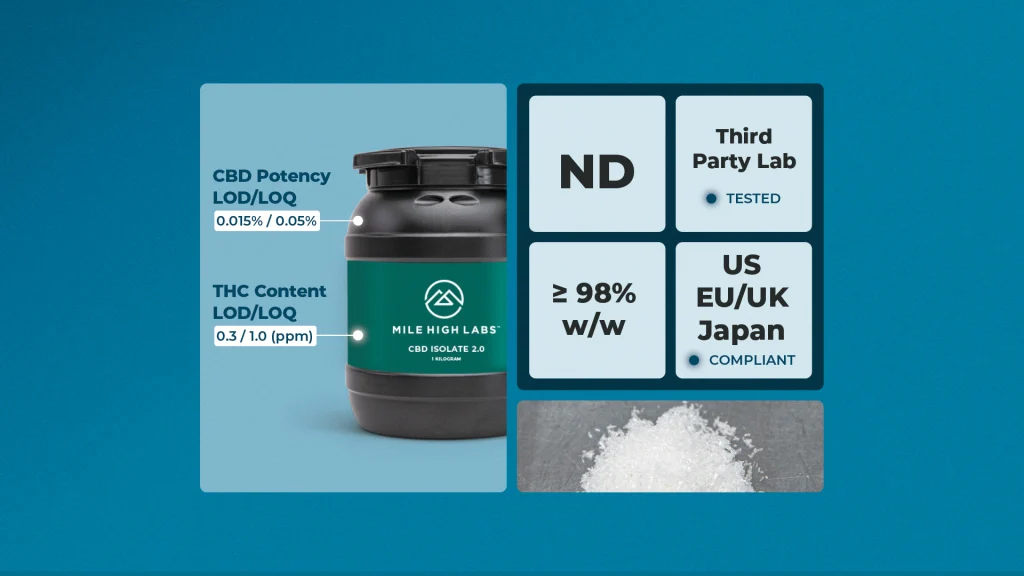
We print both on our CBD Isolate 2.0 and CBG Isolate 2.0 certificates. These products are specified for Japan and the UK, where the total THC threshold is low enough that the detection limit becomes the whole question.
Why detection limits decide who can supply you
For Japan and the UK, our specification for total THC is below 1 ppm (0.0001% w/w). At that level, the detection limit determines the markets a supplier can serve.
Two suppliers can both report ND on total THC while working to thresholds that differ by orders of magnitude. Only one of them is compliant in Tokyo.
The instrument follows the threshold, not the other way around. UHPLC meets our current specifications. Where a limit sits below what UHPLC can reliably reach, the answer is LC‑MS/MS — and that capability sits within our laboratory network.
What should concern you is the reverse: a supplier whose limit has quietly been set to suit the instrument they already own.
How we choose laboratories
We audit laboratories on three criteria:
- The LOD and LOQ their methods genuinely achieve.
- The measurement uncertainties they report.
- The accreditations they hold.
This is a quality decision, not an outsourcing one. A supplier who sends samples to whoever is cheapest and reports whatever comes back has not made a decision about quality at all.
Our laboratories are accredited to ISO/IEC 17025:2017 and certified by CDPHE. Accreditation is scoped — a lab is accredited for specific methods applied to specific sample types. A lab can hold a genuine certificate and still sit outside scope for the test or material you care about.
CDPHE certification adds a second independent audit: quality manuals, SOPs, personnel qualifications, annual on‑site inspections, and continuous blind proficiency testing.
Two audits are harder to pass than one.
Not every number is produced the same way
A good certificate tells you where each result came from:
- Accredited methods — assessed and within scope.
- Validated in‑house methods — proven but outside scope.
- Calculated values — e.g., total THC derived from delta‑9 THC and THCA.
Our certificates mark which is which in the footnotes. A certificate that presents all three identically is withholding something you would want to know.
The number behind the number: measurement uncertainty
Every quantitative result carries a measurement uncertainty — the reported value and the range around it.
A certificate reporting 99.6% CBD tells you where the needle landed. The uncertainty tells you how far the needle moves.
It is not a standard field on certificates of this kind, but the figure exists for every validated method. The uncertainties our laboratory partners report were one of the criteria we used in selecting them.
Ask for it. Whether an answer comes back at all tells you most of what you need to know.
Why the material type maters
Different forms require different validated methods:
- Isolate — minor cannabinoids appear; consistent levels indicate a characterised process.
- Distillate — terpenes and lipids produce additional peaks.
- Water‑soluble liquids — surfactants shift the baseline and affect peak resolution.
An assay validated for a crystalline powder does not transfer to an emulsion. When a supplier says their material is tested by an accredited lab, the real question is whether the method was validated for this material.
What else should be on the certificate
A complete CoA includes:
- QC and QA signatures, dated.
- Organoleptic evaluation.
- Cannabinoid content.
- THC content.
- Related cannabinoids.
- Residual solvents.
- Elemental impurities.
- Mycotoxins, microbials and pesticides.
- Lot number, manufacture and expiry dates.
- Specification and version.
- Methodology for each test.
What to ask any ingredient supplier
- Are the LOD and LOQ on the certificate?
- What is the measurement uncertainty on the assay?
- What instrumentation was used for THC?
- Was the method validated for this material type?
- Is the laboratory’s accredited scope published, and does it cover this test and matrix?
- Can this certificate be traced to this batch?
- Which markets is the ingredient compliant in?
These are not difficult questions. They are simply questions most people do not know to ask.
Why we write this down
None of this is a compliance exercise. We are not listing detection limits because a regulation says we must.
We write it down because the alternative is expensive.
A certificate that answers those questions up front is not paperwork. It is the reason the project stays on schedule.
Ask us anything in that table. You will get a number back, not an adjective, and you will get it the same day.
Working on a formulation? Ask for a sample and the full specification.
FAQ
It means the compound was not detected by the method used, at that method’s limit of detection. It does not mean the compound is absent.
LOD is the lowest concentration a method can reliably distinguish from noise. LOQ is the lowest it can reliably measure. LOD sits at roughly one third of LOQ.
The range around a reported value. Most cannabinoid certificates do not print it, but the figure exists for every validated method and can be requested from the laboratory.
No. Accreditation is scoped to specific methods and specific sample types, and that scope is a published document.
CDPHE is the Colorado Department of Public Health and Environment, the state agency that regulates hemp product manufacturing where our material is made. Its laboratory certification program is separate from ISO/IEC 17025 and runs alongside it. To hold certification, a laboratory submits its quality assurance manual, standard operating procedures and personnel qualifications for review, passes an annual on-site inspection by the department’s own subject-matter experts, and participates continuously in an approved proficiency testing program — meaning it is regularly sent blind samples and has to return the right answer.